

There's a question that gets its own slide near the start of our second AI wave session, because there's no shorter way to put it. Why are we still doing things that should have been automated ten years ago? We've asked it in Sydney, Hobart, Melbourne and online.
Our founder, Tony Brooks, started in a law firm about twenty years ago and has been the automation person in one form or another ever since, including running a legal automation business before FutureAbility. About ten years ago the tools were there and the case for automating was usually obvious, and yet the work kept being done by hand.
It still is. Matters arrive in shared mailboxes. Details get keyed into two systems. Things get checked, checked again and chased.
Why now might be the time
What's changed is the technology, though not in the breathless way it's reported every week. The tools now let us automate a whole process in a way that's tidy and maintainable. Agents are moving out of the chat window and into business processes, and building is easier than it has ever been: the demo for our session was built with a coding agent in about two weeks elapsed, roughly a week of actual effort.
This may well be the time. There's a catch, though.
The four verbs we forgot
The older school of automation had four verbs, done in order:
- Analyse the process and write down every step it actually takes.
- Eliminate the steps that aren't needed.
- Simplify what's left.
- Automate last, and only what remains.
Over the last couple of years that order got lost. The first instinct now is to jump to the fourth verb. Someone looks at a messy process and says "build an agent", points it at the whole thing, writes pages of instructions and reaches for the biggest model.
The other shortcut is quieter and far more common: people automate their own small part. A lawyer hands a few checks to her Copilot and saves time on every contract, and she's right to. But the matter still takes as long as it always did, which our piece on her contract checks follows step by step.
Both shortcuts automate the process as it is today, including the steps that shouldn't exist at all.
One matter, four verbs
The session closes on an illustrative example. It isn't a real client's matter, but it will look familiar to anyone who has worked in a firm. The matter came in by email, was saved to the desktop, saved again to iManage, keyed into Aderant, checked twice, chased and signed off on Thursday. The time anyone actually spent working on it was 1 hour 33 minutes. The time from the email landing to sign-off was 3 days and 1 hour.
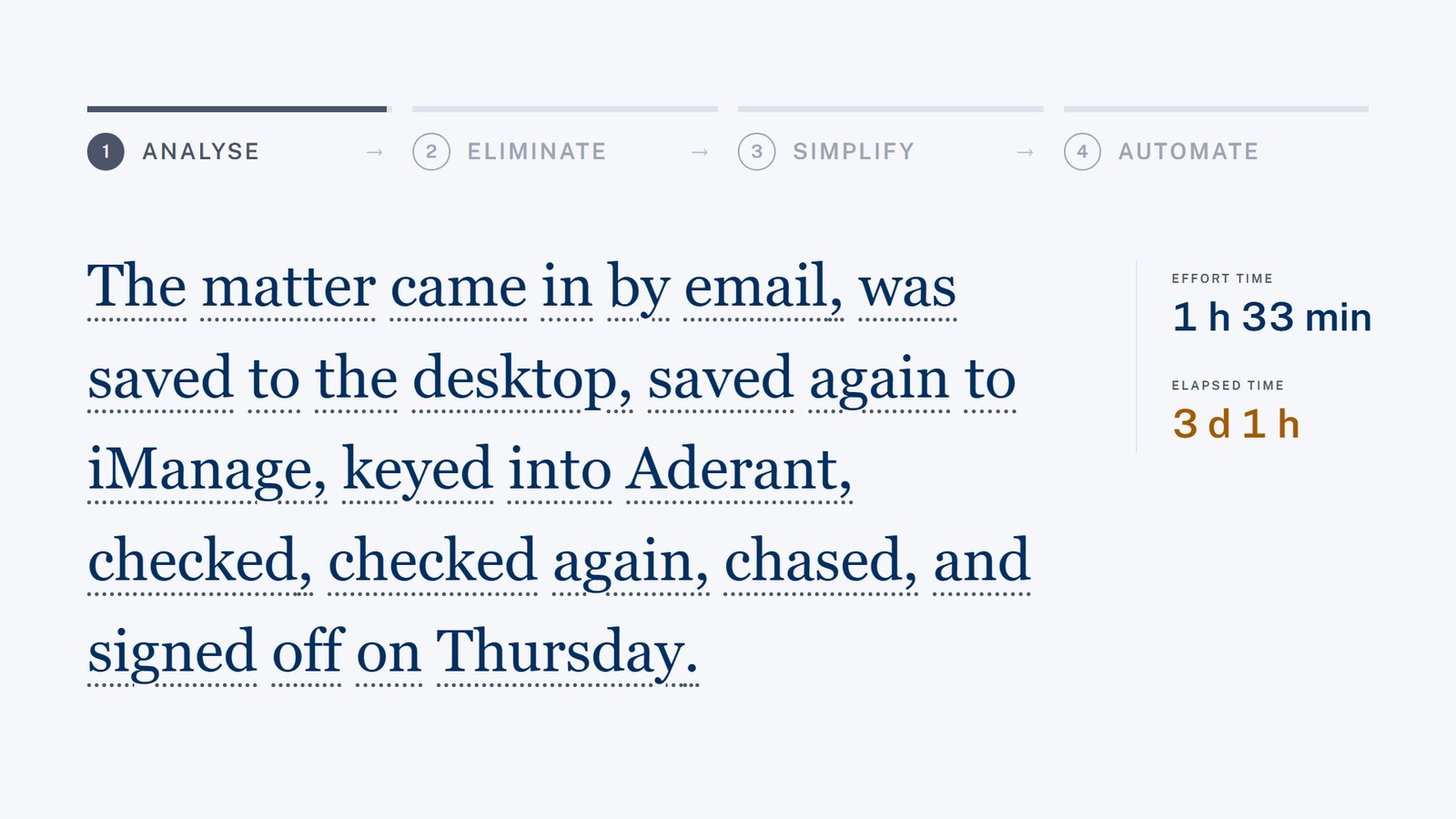
For most of its life the matter wasn't being worked on at all. It was waiting for someone to get to it, for the second check, for a reply to the chase. That gap between effort and elapsed time is what clients feel, and speeding up one person's step can't close it. When we sat down with a national law firm about their contract renewals, the process owner cared far more about the seven days of lead time than the hours of effort. We wrote up the questions that came out of it.
Now run the four verbs over that one sentence.
- Analyse it by writing the process as one plain sentence, like the one above, and timing it two ways, effort and elapsed. Then ask the person who does the work, because they know the exceptions and that's usually where the time goes.
- Eliminate by asking why each step exists. Why is the matter saved to the desktop at all? What does the second check catch that the first one misses? What's missing on arrival that makes the chase necessary?
- Simplify the duplication. The same details go into iManage and then into Aderant, so make that one entry.
- Automate what's left. Some of it is a simple rule, some needs a little reasoning, and the sign-off stays with a person. Choosing the right level of intelligence for each step is much easier once the process is short and clean.
Two of the four verbs make the process smaller before any technology touches it. People skip them, and they're what make the automation cheaper to run and easier to look after.
Giving the time back
In the end this is about people's time. The lawyers, the finance team and whoever is on the shared mailbox this week are all too busy. And the people who know how a process really works are now the biggest constraint on automating it, because building is no longer the hard part. Getting a couple of hours with the person who knows the work is, and they're busy doing the work that should have been automated ten years ago.
A good place to start is one process that runs out of a shared mailbox. Write it as one sentence covering every step, the way the matter example reads, time it two ways, effort and elapsed, and ask the process owner which one matters to them. Cross out what shouldn't be there and merge what's duplicated, and only then ask what to automate.