

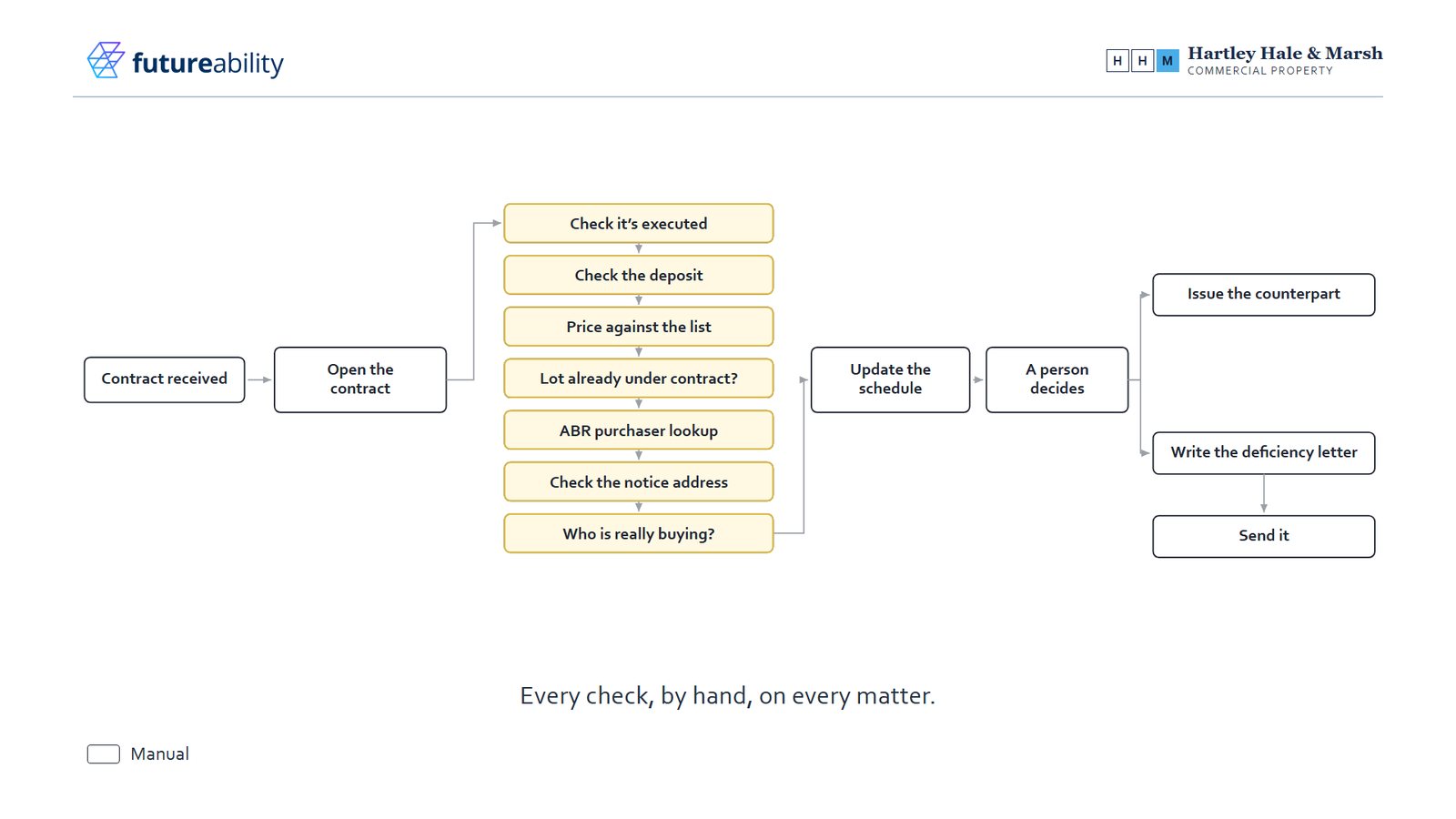
In our second AI wave session there's a lawyer who hands a handful of contract checks to her Copilot. It saves her fifteen minutes on every contract, and the slide says plainly that she was right to do it. Then comes the line the rest of that section hangs on: she made her step faster, and she did not make the matter faster. The gap between one person's step and the whole matter is where we think the second wave is happening.
Hartley Hale & Marsh is our demo firm, a commercial property practice with made-up contracts. Anyone who has worked near a property team will recognise it.
A developer engages the firm to sell the lots on a site. There might be two hundred of them, each with its own price, and there are rules about who can buy: the purchaser must be a trust or a company, registered for GST. Every contract that comes back goes through the same workflow, two hundred times.
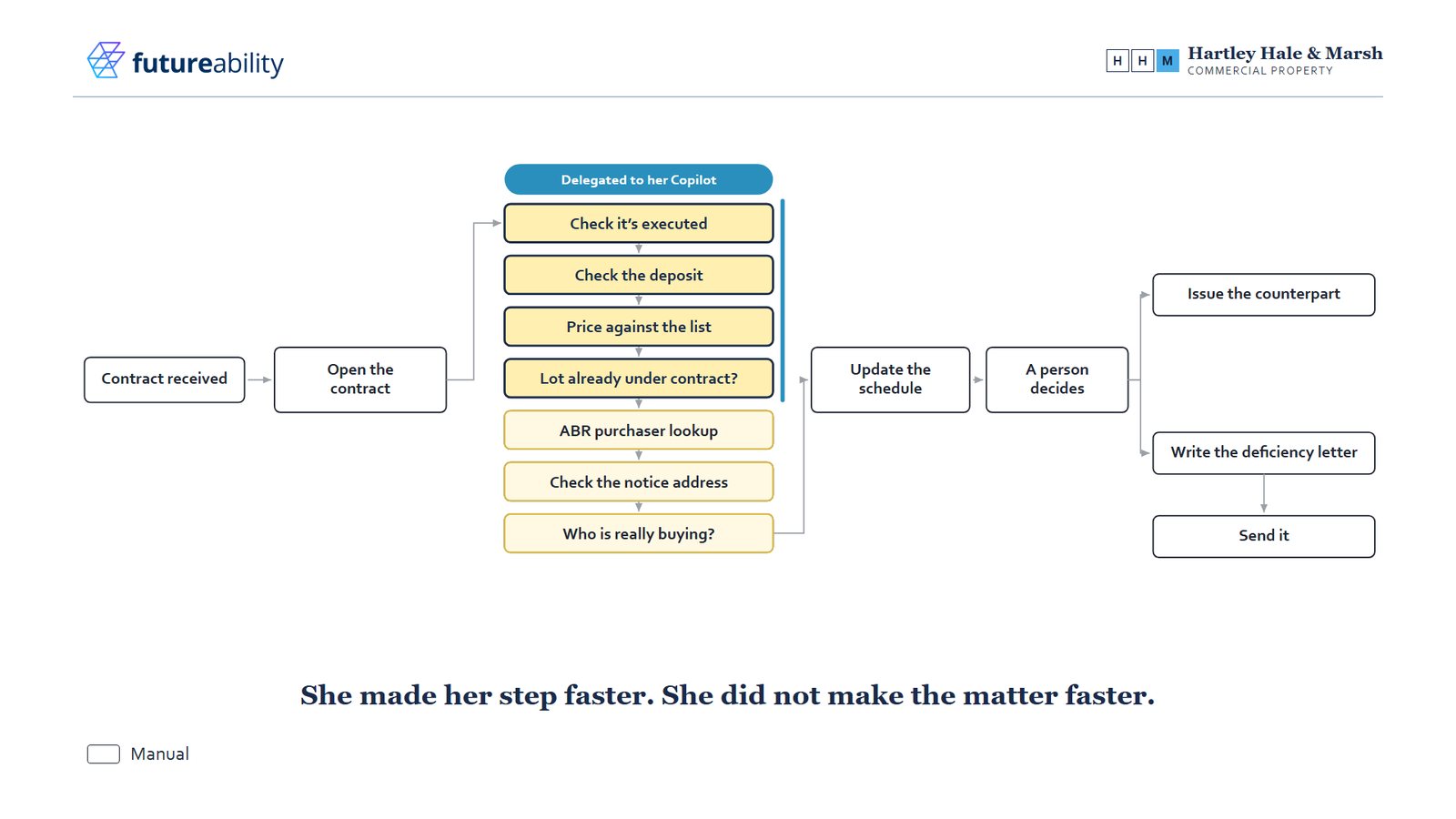
It starts where so many processes start, in a shared mailbox. The signed contract lands, a lawyer opens it, and the checking begins.
- Is it executed properly?
- Is the deposit right?
- Does the price match the price list?
- Is the lot already under contract? That's a trip to the register.
- Is the buyer registered for GST? That's a lookup on the Australian Business Register.
- Is the notice address legitimate for the buyer?
- Who is really buying?
The last one takes actual thought. If the buyer is a trust, you look at the trust and the holding company behind it. In one demo contract a third company name turned up that matched none of the others. That isn't a yes or no question.
If everything checks out, the lawyer updates the schedule and a person decides whether to proceed. If yes, the firm issues the counterpart. If not, someone writes and sends a deficiency letter.
She was right to delegate
Now add the tools most people have today. Our lawyer has Copilot, and she's handed it part of the job: read the contract, run the first four checks and draft the chase if one is needed. She saves fifteen minutes per contract.
It's the right thing to do, and it's where most people start. Most agents built so far are employee productivity and support agents like hers.
It's also where many organisations are with their complex processes: people automating their own small parts while the process looks exactly as it did.
Why the matter didn't get faster
Look at what hasn't changed for the matter. The contract still sits in the shared mailbox until someone gets to it. She still does the GST lookup, the address check and the who's-really-buying work herself. Somebody still updates the schedule by hand, the decision still waits for a person, and the counterpart or the letter goes out only when all of that is done.
The fifteen minutes is real, but it comes out of one person's effort. The time the matter spends inside the firm is every step plus all the waiting in between, and the client feels all of it.
We saw this on a contract renewal process for a national law firm. We walked in thinking the hours saved were the story, and the process owner cared far more about the lead time, which ran to a week or more end to end.
Look at the whole process
Process automation starts with a different question. Instead of asking which bit of my job Copilot can do, it asks how this matter should move from the mailbox to a signed counterpart. That's process re-engineering, and the discipline is old: analyse, eliminate, simplify, then automate, in that order. Our piece on the four verbs takes them one at a time.
Look at Hartley Hale & Marsh that way and the steps sort into four kinds:
- Some are rules, such as whether the deposit is right and the price matches the list.
- Some are lookups, such as whether the lot is already under contract or the buyer is registered for GST.
- Some need judgement, such as reading the contract and working out who's really buying.
- One stays with a person, who decides whether to go ahead with everything they need in front of them.
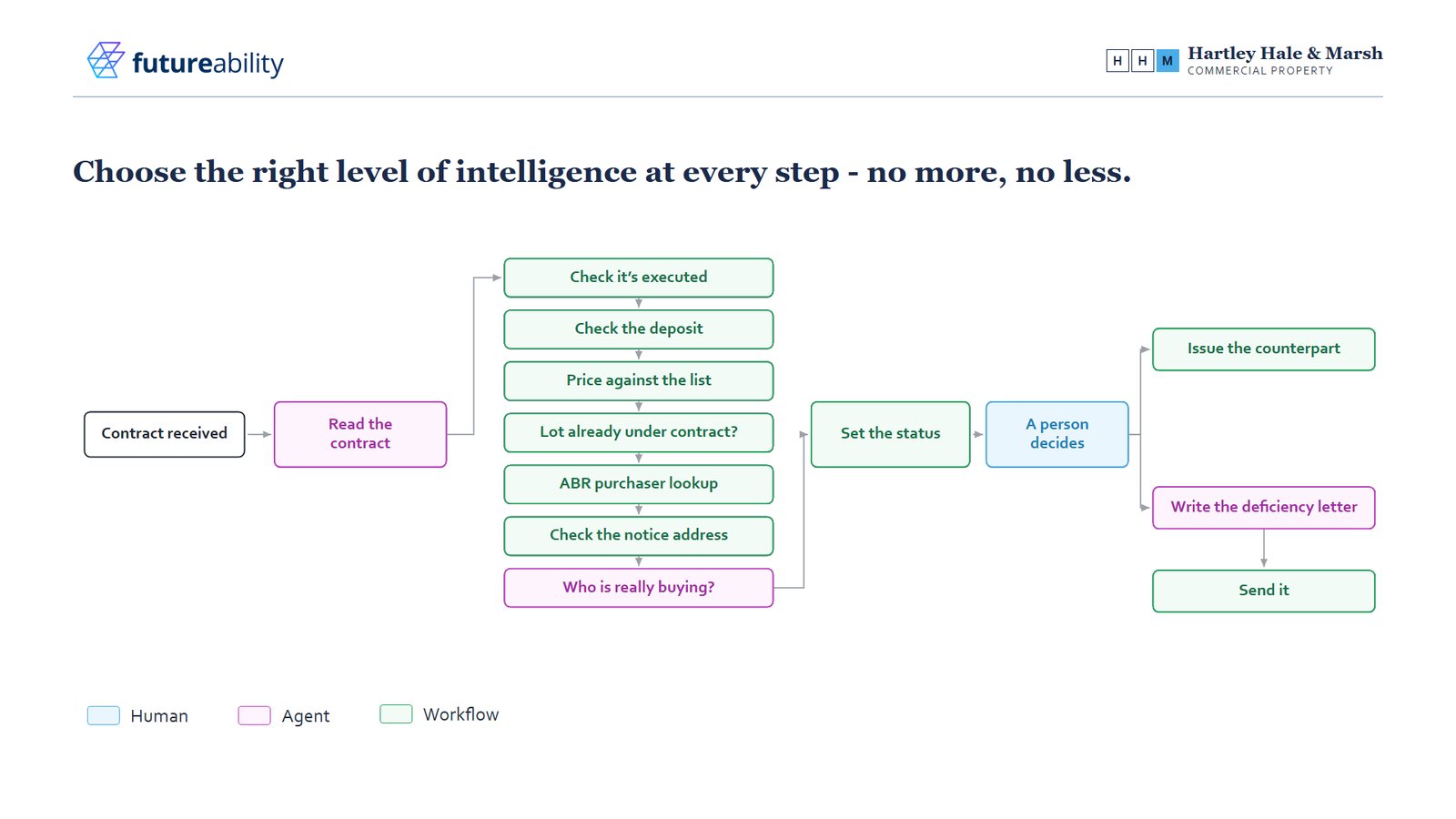
Most of that doesn't need AI at all, and the part that does needs only a little. In the demo, the contract that failed on GST was caught by a register lookup in the workflow: look up the ABN, not registered, exception flagged. The contract with the mystery third name needed some reasoning, though not much. Getting that split right is what we mean by choosing the right level of intelligence.
The tempting shortcut is to point one big agent at the whole process, with a prompt that tries to cover every check and every exception. It costs more than it should and works worse than you'd hope.
Start with one shared mailbox
Hartley Hale & Marsh is a law firm, but the same shape applies to any process that starts in a shared mailbox, such as contractor invoices or broker requests. Something arrives, someone opens it, checks it against a few rules and a register or two, makes a call and sends something back, by hand, every time. Often someone has already sped up their own step, and they're worth finding, because they're showing you where the process hurts.
To try it, pick one type of item that lands in a shared mailbox and follow one from arrival to the last email out, writing down every step, including the waiting. Mark each step as a rule, a lookup, a judgement or a person, then ask the process owner which matters more to them, the effort or how long the whole thing takes. We'd expect the waiting to outweigh the working, and no personal productivity tool fixes that on its own.