
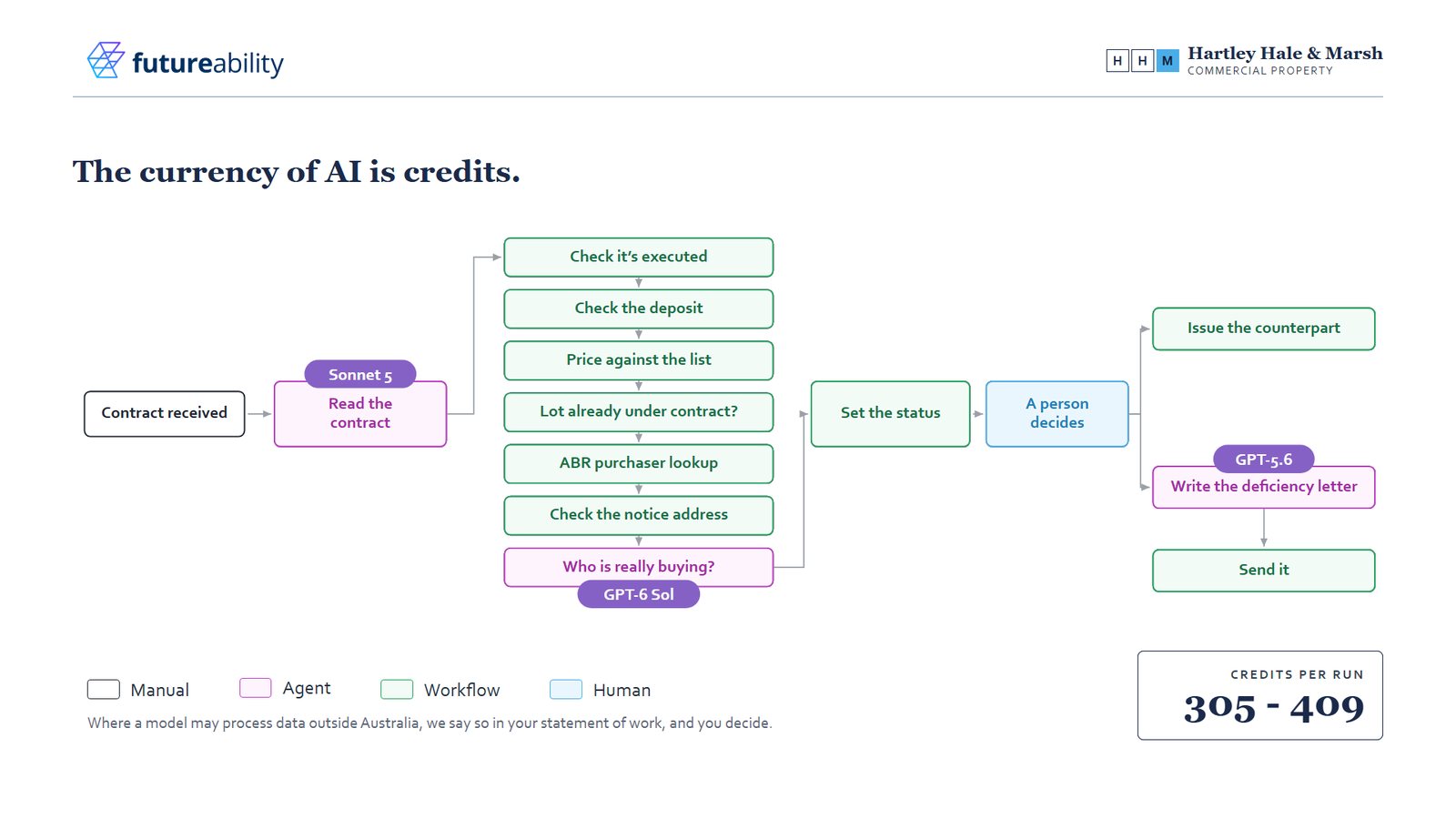
When the all-agent slide goes up in our second AI wave talk, the box in the corner shows a range: 545 to 1,156 credits per run. Same contract, same agent, and one run can cost more than twice another depending on where the agent decides to wander that day. The figures are illustrative, made up for the slide, but the spread is what the slide is about.
The meter is on
AI cost used to be easy to ignore, especially on flat-rate personal plans. In the enterprise that has changed: Copilot Credits meter agent work in Copilot Studio, and Microsoft's published pay-as-you-go rate is one US cent a credit.
Billing for agents built in the GitHub Copilot harness began on 1 September 2026, and building in that harness costs credits too: natural-language authoring, previewing and evaluating all draw on the meter.
Visible cost is welcome, and it brings a new risk of burning credits. How many you burn comes down to design.
One process, three designs
The talk follows one contract through Hartley Hale & Marsh, our made-up property law firm. The contract lands in a shared mailbox, gets read, runs through seven checks, and a person decides whether the counterpart or a deficiency letter goes out. Done entirely by hand, it uses no credits, and it uses people on every check of every matter.
The first instinct is to point an agent at the lot: read the contract, run every check, set the status. Illustrative cost: 545 to 1,156 credits per run, or roughly US$5 to $12 every time a contract comes in.
The range is wide because an agent has agency. You give it instructions and tools and it chooses how to get the job done. Sometimes it heads off somewhere for a while and comes back, and every extra turn resends the instructions and the growing context.
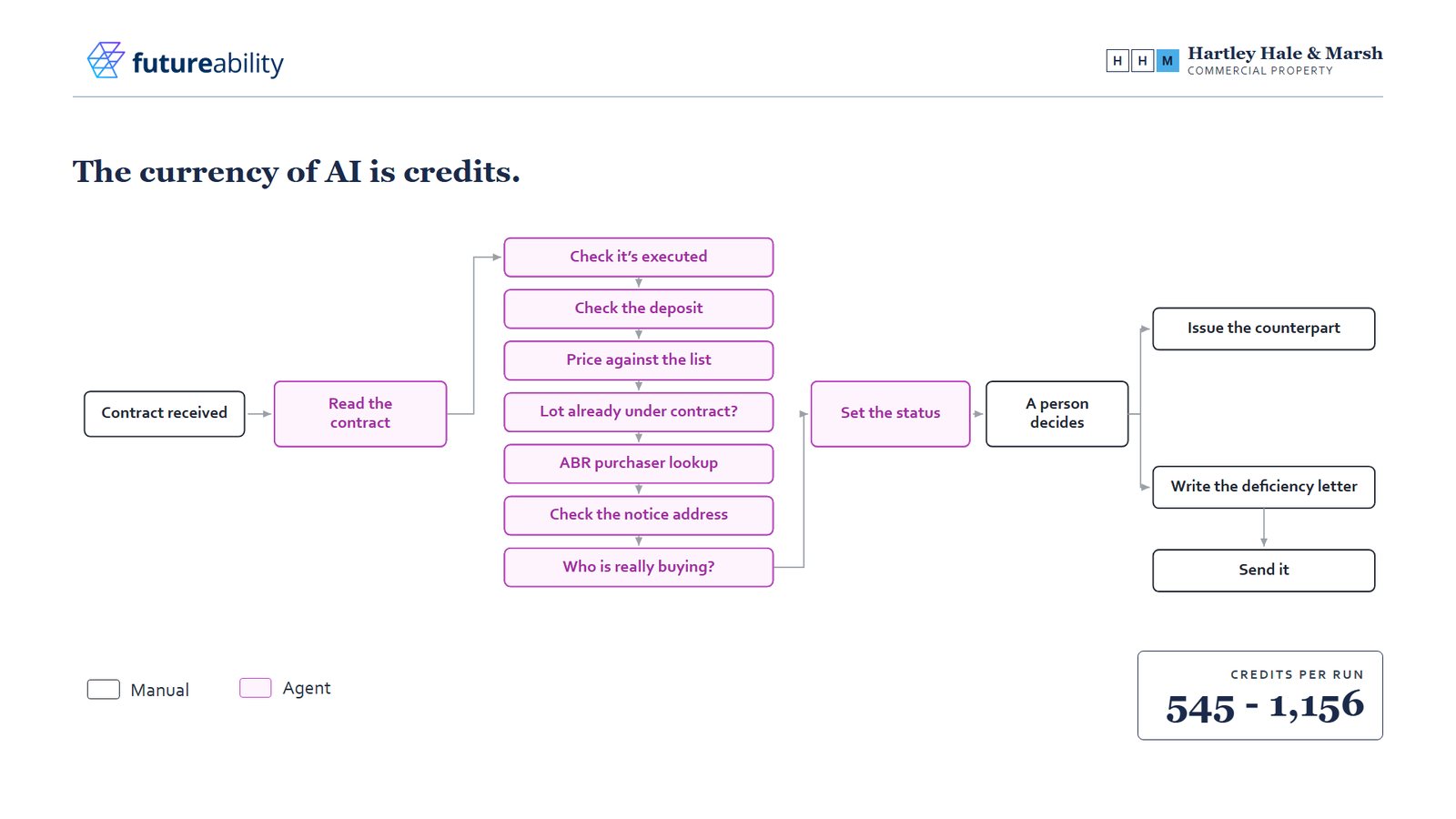
The second design hands the deterministic steps to a workflow: is the deposit right, is the lot already under contract, is the buyer registered for GST on the Australian Business Register? Those are rules and lookups. The agent keeps the three steps that need some thinking, which are reading the contract, working out who is really buying and drafting the deficiency letter, and a person still makes the call. Illustrative cost: 403 to 628 credits per run.
Workflow steps aren't free. They still use credits, a fraction of a credit each. The saving comes from moving work off the expensive part, and from agent instructions that no longer have to spell out every check.
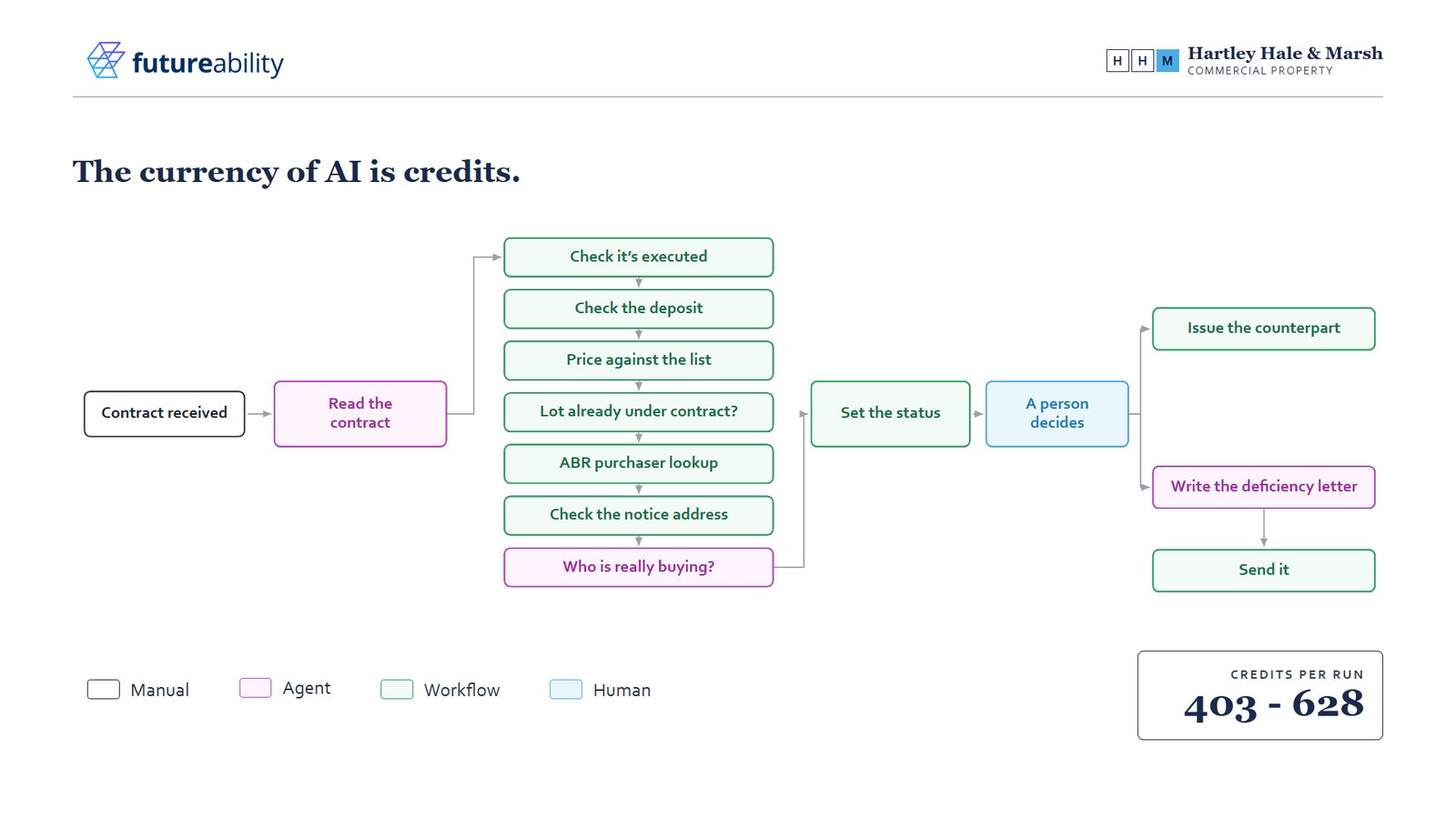
The third design keeps that split and picks the right model for each AI step. Reading a contract, untangling who sits behind a trust and drafting a letter are different jobs, and they don't all need the biggest model. On the slide each of the three AI steps runs on a different model. Illustrative cost: 305 to 409 credits per run, or roughly US$3 to $4.
This design puts the right level of intelligence at every step and the right model at every AI step. Keeping the model separate from the process also lets you swap models as better ones arrive. Where a model may process data outside Australia, we say so in the statement of work and the client decides.
Certainty matters as much as cost
All four side by side, with every credit figure illustrative:
| Design | Credits per run |
|---|---|
| Manual | None, all people |
| All agent | 545 - 1,156 |
| Agent, workflow and person | 403 - 628 |
| Plus the right model per AI step | 305 - 409 |
The top of the range drops from 1,156 to 409. Look at the gap as well. On the all-agent design the dearest run is more than double the cheapest, and on the last design it's about a third more.
That narrowing is the part we care about most, because cost certainty is one of the biggest challenges we're seeing with clients. A process owner can sign off on roughly US$3 to $4 a run. Somewhere between US$5 and $12, depending on where the agent goes that day, is a much harder conversation. Ask the process owner early what a run is worth to them, one of the three questions we put to every process owner.
Because building costs credits too, certainty matters before anything goes live. Every round of "let's just try the bigger model" during the build shows up on the meter.
Experiment on a capped credit budget
Keep experimenting, somewhere the bill can't run away from you. Create an environment in Power Platform, allocate it a set number of credits, cap it, and give it only the tools you want people using. People get room to learn while the spend stays bounded.
For holding those credits, if you're happy to commit for twelve months, a capacity pack is usually the most cost-effective route: Microsoft's Australian list price is $299.30 a month, ex GST, for 25,000 credits. Our guide to buying credits sets out when pay-as-you-go is the better choice.
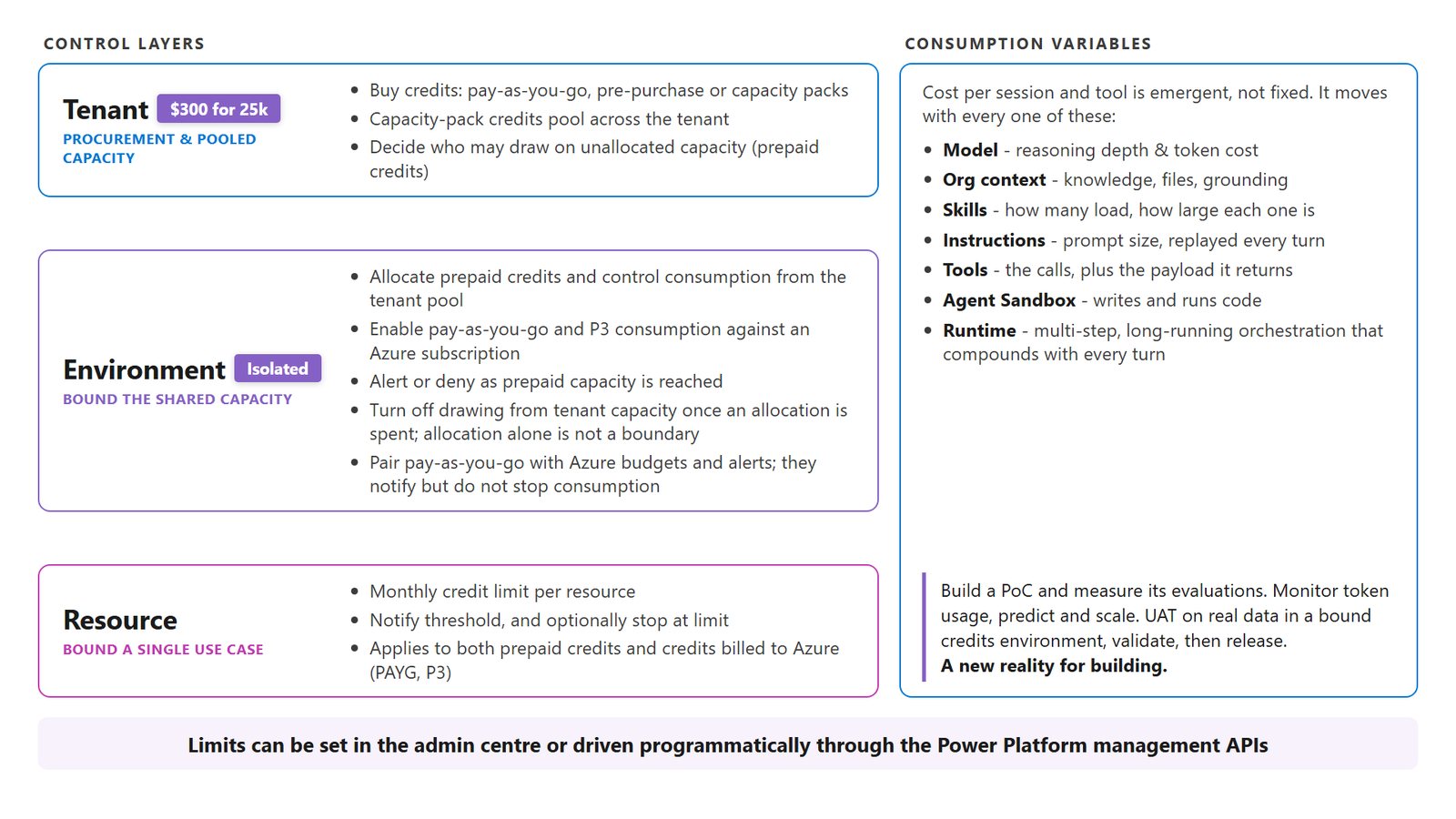
Limits sit at three layers. The tenant is where you buy, and capacity pack credits pool across it. The environment is where you fence off part of that pool: allocate credits, then alert or deny as they run out. One catch is that allocation alone isn't a boundary, so also turn off drawing from tenant capacity once the allocation is spent. The resource is where you bound a single use case, with a monthly credit limit, a notify threshold and an optional hard stop.
The right-hand side of that slide is the honest part. Cost per session is emergent. It moves with the model, the organisational context you ground the agent in, how many skills load and how big they are, the instructions replayed every turn, the tools and what they return, the sandbox where an agent writes and runs code, and long multi-step runs that compound with every turn.
A discipline called AI FinOps is forming around managing this. Our short version: give people a governed area to experiment in, know what a run costs and know what it's worth.
Where to start
Pick one process and colour every step: green for rules and lookups, pink for steps that need judgement, blue where a person decides. Ask the process owner what one run is worth to them, then set up an environment with an allocated, capped credit budget and only the tools that process needs. Run it on real examples and write down the cheapest and dearest runs as well as the average, because a wide gap is a sign the agent may be doing work a workflow could do.
Sources and further reading
Microsoft Learn - Copilot Studio billing and licensing
Microsoft Learn - Manage costs for agents powered by the GitHub Copilot harness
FutureAbility - The three ways to buy Copilot Credits
All credit figures for the Hartley Hale & Marsh designs are illustrative, prepared for the talk and not measured. Microsoft sets credit rates and list prices and they change; check current figures with your Microsoft account team or licensing provider.