

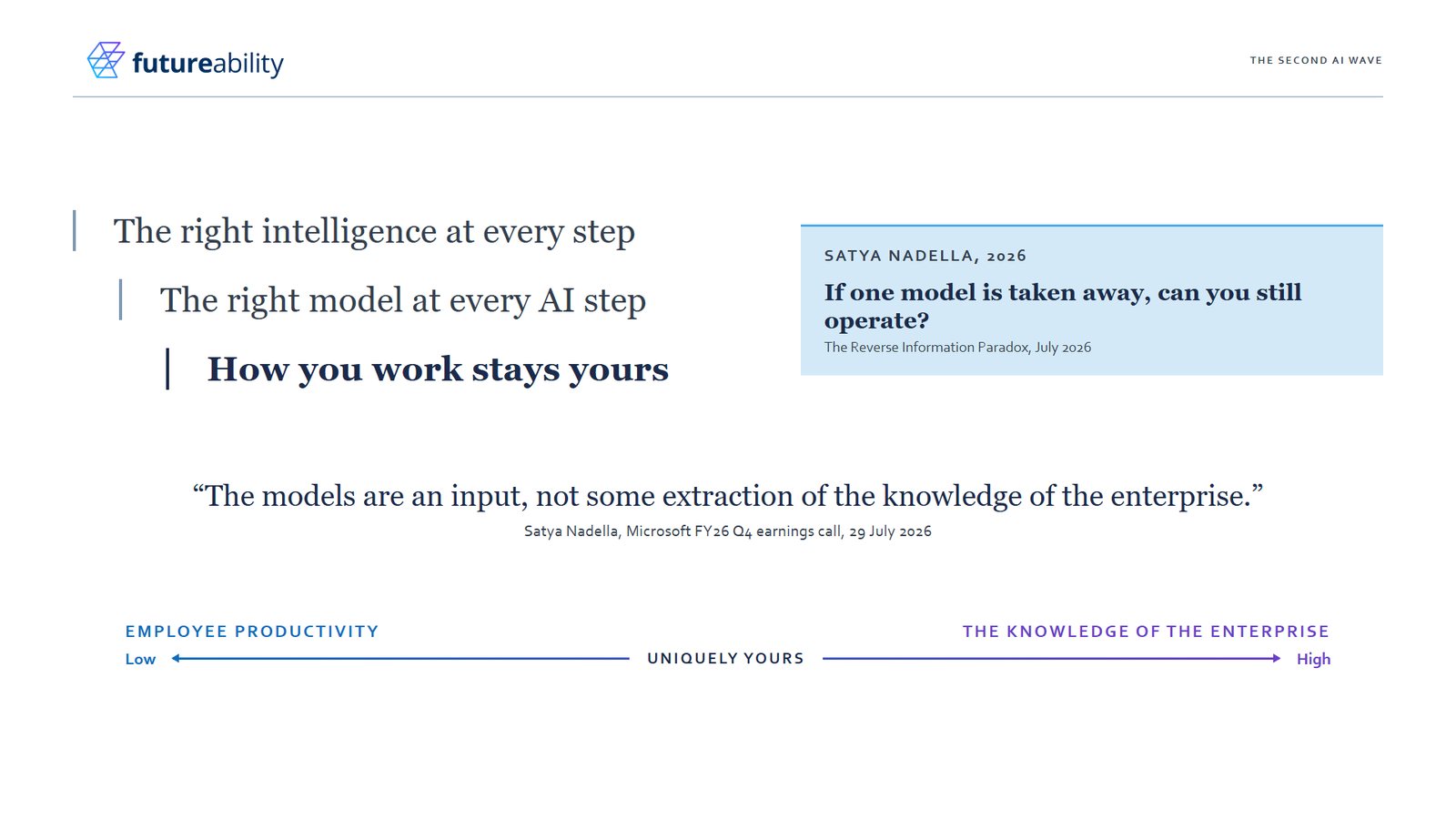
FutureAbility is about as dependent on one AI provider as anyone: the whole demo for our second AI wave talk was vibe coded in Claude Code. When Tony Brooks put a question from Satya Nadella on screen in the online session, it was aimed at us as much as the room. If one model is taken away, can you still operate? For our own build work, we'd grumble and cope. For a business process your clients depend on, you want a clear yes.
Paying for it twice
How dependent are you on the models you've rolled out? If your instructions only work because they're tuned to one model's quirks, and your best people's know-how has gone into it one chat at a time, the answer to Satya's question might be no.
He put the other half of it on Microsoft's earnings call in July:
"The models are an input, not some extraction of the knowledge of the enterprise."
Satya Nadella, Microsoft FY26 Q4 earnings call, 29 July 2026
The model is an ingredient you feed into your process, and your process shouldn't end up living inside it.
If it does, you pay twice. You pay once in credits to use the AI, a cost that's now visible. And in some cases you pay a second time with your IP: the rules, the judgement calls and the way your people do the work, poured into a model you don't own and can't take with you.
The part that's uniquely yours
Some work looks much the same in every organisation: search and Q&A, writing and drafting, summarising, analysing data, file notes and correspondence. Most agents built so far do exactly this kind of employee productivity and support work. If your favourite model vanished tomorrow, another one would draft your emails just fine.
Then there's how your business operates: how you scope and price work, run a matter, win work and serve your clients in very specific ways. That part is uniquely yours, and it's the reason people still go to their law firm for advice when they could type the question into a legal AI tool. They're paying for how the firm thinks about their problem.
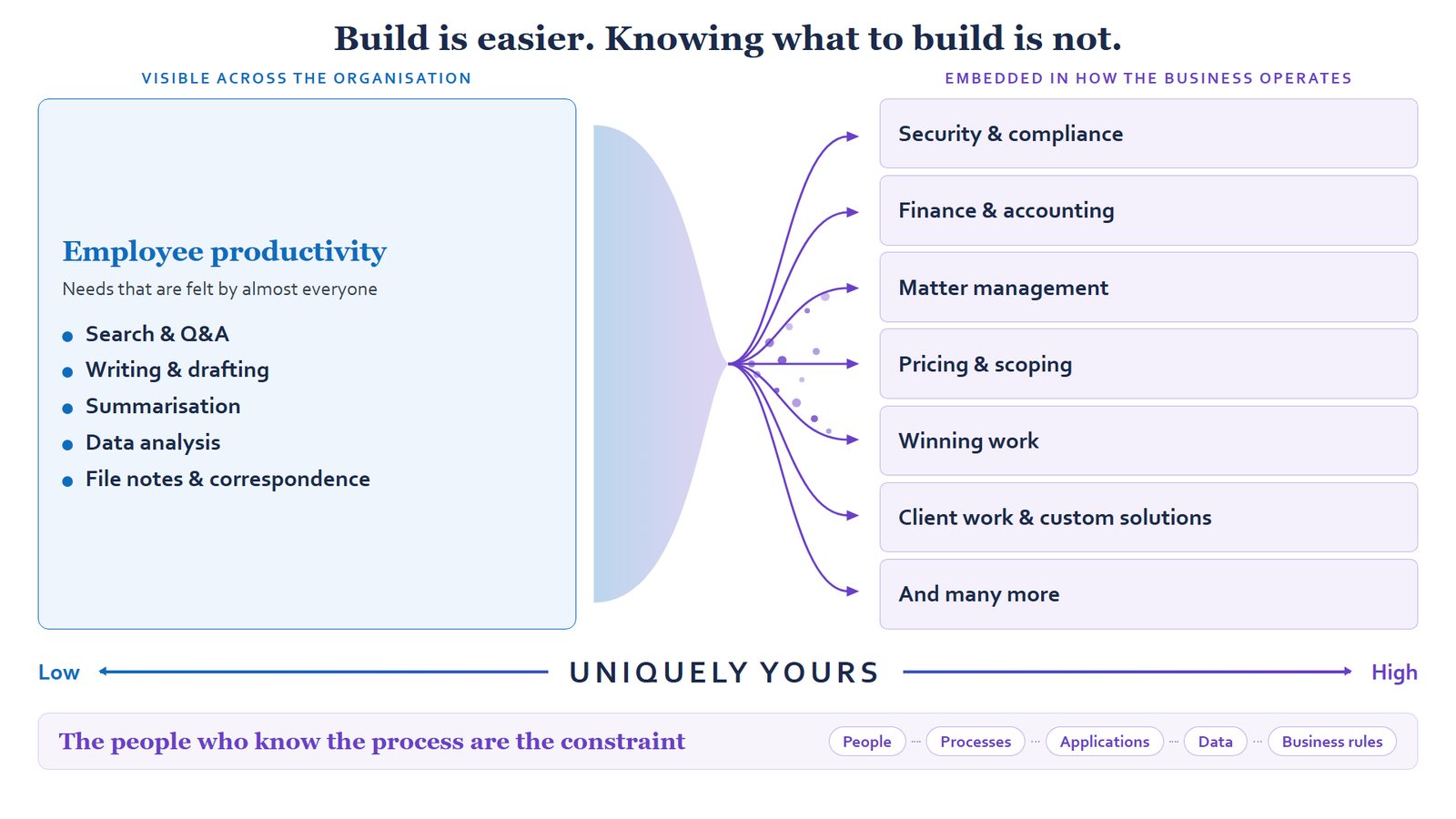
That right-hand side is where the second wave is heading, and it's the side you most need to keep hold of.
Separate the model from the steps
To automate the uniquely-yours work without handing it over, keep the model separate from the steps of the workflow.
In the session our example was Hartley Hale & Marsh, a law firm (made up for the demo) whose property contracts land in a shared mailbox. Every contract goes through seven checks before a person decides what happens next.
Only two steps in that process really need AI: reading the contract in the first place, and working out who is really behind a trust or holding company. Everything else is rules and lookups that belong in a workflow, and sorting one kind of step from the other is a skill in itself.
Laid out like that, the knowledge sits in places you own:
- The workflow holds the order of the steps and the business rules, such as flagging a buyer who isn't registered for GST.
- Skills hold how a task is done, like the steps for drafting a deficiency letter, so the agent does it the same way every time.
- Dataverse holds the data and where every matter is up to, in your own environment.
The model is the engine you drop into the AI steps, and each step can have its own: a lighter model where the job is simple, a stronger one where it has to reason. That brings your credits down too.
It also means models can come and go. When a new one turns out to be better at a particular step, you change the model on that step and test it, without rebuilding the process or rewriting a long set of instructions.
The same thinking makes us less worried about our own build work than we sounded at the start. The plugins we use in Claude Code are skills for building on Power Platform, and skills follow an open format, so they can often move between tools. The skills stay ours whichever tool we rent, which is the idea behind the machine that builds the machine.
What about trade secrets?
Someone asked in the Q&A whether using frontier models puts trade secrets at risk.
Many of the firms we work with have turned Anthropic's models off at tenant level, usually for data sovereignty (where the data is processed) more than data security. Each of the big providers says it doesn't take your data, and most publish transparency notes on how they handle it. At some point you take them at their word, and it comes down to your organisation's level of comfort.
The practical advice is simpler: be careful what you share. If something is that secret, you wouldn't want it in there anyway.
Where a model may process data outside Australia, we say so in the statement of work, and the client decides. Where data goes when Claude runs inside Microsoft products is set out in our Claude data residency briefing. The global switch that lets Microsoft 365 Copilot use Anthropic models has been on by default for Australian commercial tenants since 7 January 2026.
Separating the model from the steps helps here as well. If you decide a model shouldn't touch a certain kind of data, you change the model on that step and the process keeps running.
Three things to check
- Ask Satya's question about one process that matters, and work out what you'd lose if the model behind it disappeared. If the answer is instructions that only work with that model, or know-how that lives in someone's chat history, that's your to-do list.
- Move the know-how somewhere you own. Pull the business rules out of long agent instructions and into workflow steps, the how-to into skills and the data into Dataverse.
- Check your tenant and your paperwork. Know which models are switched on and where they process data, and make sure anyone building for you puts that in writing.